Buying
Solar Panels on a Property: Ownership, Paperwork and Maintenance Questions
Existing panels can be useful, but their appearance does not tell you what you will own or save. Check the equipment, contracts, installation records and ongoing responsibilities, then assess the system against the way you plan to use the home.
Published · 10 min read
By Costa de Oro · Real-estate agency · Marbella & Costa del Sol
Identify the system and establish who owns it
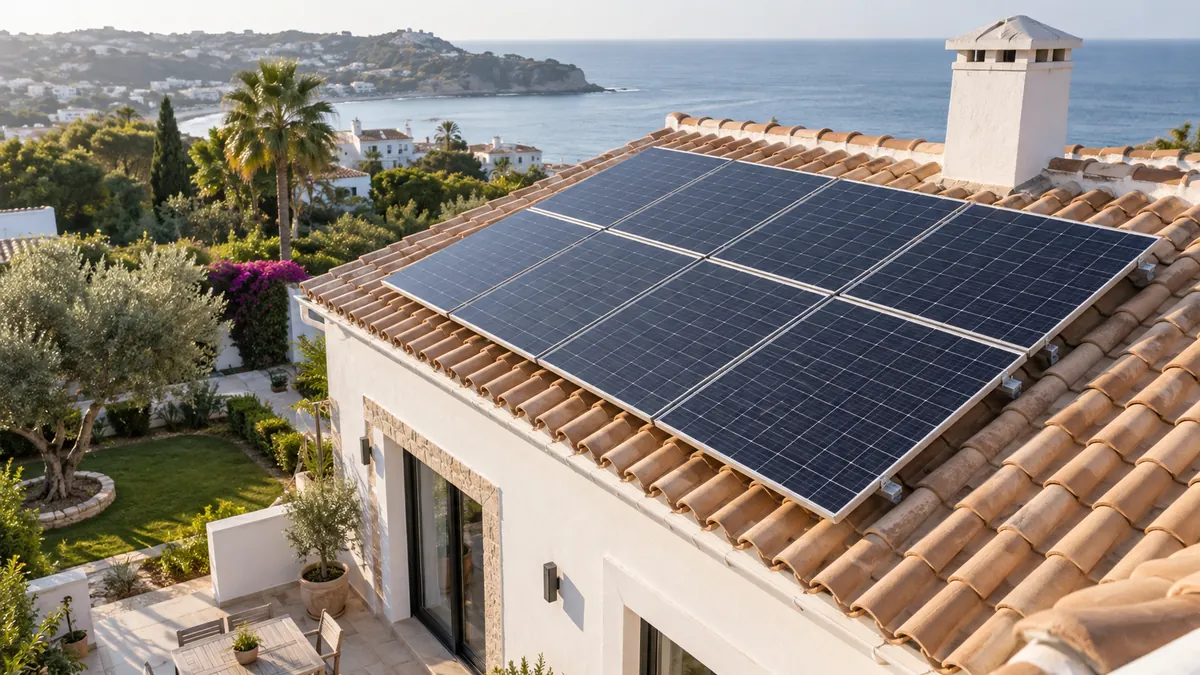
First establish what the panels do. Solar thermal equipment heats water; photovoltaic panels generate electricity. A home may have either or both. Ask for an equipment schedule identifying the panels, inverter, any battery, monitoring system and installation date. A photograph is not an inventory, and a battery-shaped cabinet should not be assumed to provide usable household backup.
For a photovoltaic system, distinguish panel capacity, usually stated in kWp, from energy produced over time, measured in kWh. Obtain the installer’s specification rather than inferring capacity from panel count. Identify whether the system serves only this home, common areas or a collective arrangement. The presence of panels on the roof does not necessarily mean the dwelling receives all their output.
Ask who legally owns each component and whether it is bought outright, financed, rented or supplied under a service agreement. Request invoices and relevant contracts, including outstanding payments and any removal, transfer or termination provisions. Have your lawyer establish what will transfer with the property and how obligations will be dealt with. Do not assume that paying for the house automatically extinguishes a separate equipment agreement.
Record the roof or land used by the installation and the rights needed to access it. A private terrace, an exclusive-use roof and a privately owned roof are not necessarily the same legal arrangement. If a third party owns equipment or uses the roof, investigate the agreement before treating the installation as an asset included without conditions in the sale.
Match the paperwork to the equipment actually installed
Request a coherent installation file, not simply a sales quote. Useful records include the electrical installation certificate, technical design report or project as applicable, commissioning or registration evidence, equipment specifications, diagrams, installer details and subsequent modifications. Ask a qualified installer which documents are required for this particular system, its date, power, connection and configuration.
Junta de Andalucía explains the regional process for legalising and activating self-consumption installations, including the CAU identification code and relevant PUES procedures. Technical registration, communication with the distributor and the supply contract are related stages, not interchangeable pieces of proof. A recent bill showing export compensation does not by itself establish that every building or electrical requirement was correctly addressed.
Match the file to the actual address, CUPS supply point, CAU, equipment and capacity. Ask whether a later battery, extra panels or replacement inverter changed what was registered or authorised. Have discrepancies explained and, where necessary, corrected through the appropriate professional and authority. A document for the original system may not describe what is now on the roof.
Check any applicable municipal permission, declaration, heritage restriction or roof-work approval separately. The correct procedure depends on the property and works; this guide does not say that every installation requires the same licence. Where a document is missing, establish what can be recovered, who must act, the likely process and a written cost estimate before assuming the problem is only administrative.
Assess generation and bills using your own consumption pattern
Ask for a useful run of generation records and electricity bills, preferably covering a full seasonal cycle if available. Compare dates and identify missing periods, faults or changes in occupancy. A monitoring screenshot from a sunny afternoon does not establish annual output, and the seller’s spending may reflect a household very different from yours.
Separate generation, energy used directly at the property, energy exported and electricity bought from the grid. Under the simplified compensation mechanism in Royal Decree 244/2019, exported electricity is financially offset subject to the mechanism’s billing limits; it is not automatically credited at the same price as imported electricity. A supplier’s “virtual battery” or credit product has its own commercial conditions and is not a physical backup battery.
Hypothetical arithmetic only: assume 6,000 kWh generated in a year, of which 2,400 kWh is used directly and 3,600 kWh exported. At invented values of €0.20 per avoided imported kWh and €0.06 per exported kWh, the preliminary figures are €480 and €216, totalling €696. This is before applicable billing limits, fixed charges, taxes, losses and maintenance. It is not a tariff offer or a savings forecast. The simplified mechanism works by billing period, which cannot exceed a month. Annual export totals therefore cannot simply be netted against winter imports. Ask the supplier to show how the actual bill and any separate credit product would treat the pattern.
A holiday-home buyer may use less electricity during solar-producing hours than a resident seller. Rework the calculation using your intended occupancy, hot water, cooling and vehicle charging. Ask for the actual compensation contract and bills showing activation, not a promise that solar means no electricity bill. Do not infer a resale premium or payback period from the installation’s original price.
Inspect condition, roof interfaces and ongoing costs
Have a qualified professional inspect the installation and its connection to the building. Ask about mounting, roof penetrations, weatherproofing, visible damage, corrosion, cabling, inverter location and ventilation. A normal property survey and a specialist electrical assessment can answer different questions. The seller switching on a monitoring app is not a technical condition report.
Review maintenance records, repairs, fault history and equipment warranties. Distinguish a panel’s output warranty from product cover, installer workmanship, labour and transport. Ask the manufacturer or installer what transfers, which registration is needed and which documents support a claim. A long warranty headline does not explain who will diagnose a fault or pay for safe access and removal.
Obtain realistic estimates for identified work and likely replacement items based on the equipment’s age and condition. Ask who services the inverter and battery, whether compatible parts and monitoring support remain available, and what a visit involves. Do not assume a standard replacement age or annual maintenance price. For batteries, request the relevant condition information and warranty limitations rather than relying on original nominal capacity.
Cleaning and access should follow the manufacturer’s and installer’s guidance. Buyers should not climb onto a roof or handle electrical equipment during a viewing. Ask how safe maintenance access is provided and who is responsible for it. Check the insurer’s requirements and whether existing cover includes the equipment, associated damage and relevant liabilities; obtain confirmation for the policy you intend to use.
Plan the transfer, monitoring access and backup expectations
Arrange the change of electricity account and relevant self-consumption details with the retailer, distributor and installer as appropriate. Ask which records must change, what evidence they require and how billing will be checked after completion. A property sale, a supply-account change and the continuation of a compensation arrangement should not be assumed to complete themselves as one automatic action.
Prepare a handover inventory: serial numbers, manuals, diagrams, service contacts, warranty documents, monitoring ownership and authorised account access. Transfer administration through the provider’s process and address the seller’s remote permissions. If monitoring depends on the home’s internet, coordinate the router and network change rather than assuming the installation has failed when an app stops reporting.
Ask separately about power during an outage. A normal grid-connected photovoltaic system is not proof of backup capability; suitable isolation, equipment and configuration are required. Manufacturer SMA’s guidance explains this distinction. Even where backup exists, confirm which circuits it supplies, its power limits and operating conditions. A battery alone does not establish that the whole home will keep running.
Have the installer explain and, where appropriate, demonstrate the system safely. Do not test by switching electrical equipment yourself. Ask your lawyer about any grants, tax benefits, finance or contractual conditions attached to the installation and what the seller must resolve. Do not assume a benefit awarded to the seller transfers to you, or include unconfirmed future subsidies in the buying budget.
Make a documented decision about the system you will inherit
Organise the findings under ownership, compliance records, operating performance, condition, shared obligations and handover. Mark each item evidenced, requiring clarification or requiring work. This makes a useful purchase discussion: “the battery ownership contract is missing” is more actionable than a general impression that the panels look modern.
For a hypothetical comparison, one seller provides a matched installation file, bills and transferable warranty information, while another provides only an app screenshot and an unresolved equipment agreement. The second property needs further investigation even if its array appears larger. Neither example establishes that an installation is good or bad from appearance; the difference is the evidence available to assess it.
Ask the relevant professional for the next action on each material issue, including responsibility, cost estimate and dependencies. Discuss unresolved ownership or documentation with your lawyer before paying a deposit. A suggested price adjustment does not legalise equipment, transfer a contract or repair a roof. Keep any proposed remedial work distinct from work that has been completed and checked.
Tell Costa de Oro whether solar is essential, which documents remain outstanding and whether a shared installation or maintenance responsibility changes your preference. We can coordinate available seller information and access for professional checks. The aim is to understand what you will own, how it works and what it may require, then compare the property on a budget supported by evidence.
Common questions
Are solar panels automatically owned outright by the seller?
Do not assume so. Check invoices, finance, rental or service contracts and any third-party roof rights. Have the purchase documentation specify what transfers and how outstanding obligations are handled.
Will exported solar electricity make my bill zero?
Not automatically. Direct use, export compensation, imported electricity, billing limits and other charges are different items. Assess the actual contract and your consumption pattern; the worked figures here are hypothetical.
Does a battery guarantee power during an outage?
No. Ask an installer to confirm the backup equipment, isolation, configuration, supplied circuits and limits. Physical storage, monitoring and a commercial “virtual battery” credit product serve different purposes.