
Buying
Buying a Property to Renovate in Marbella: Permissions, Budget and Risks
A dated home can offer room to improve the layout and comfort, but the asking price is only the beginning of the decision. Before buying a property to renovate in Marbella, establish what exists legally, what your proposed work requires and how you will fund the complete project, including the time before you can move in.
Published · 11 min read
By Costa de Oro · Real-estate agency · Marbella & Costa del Sol
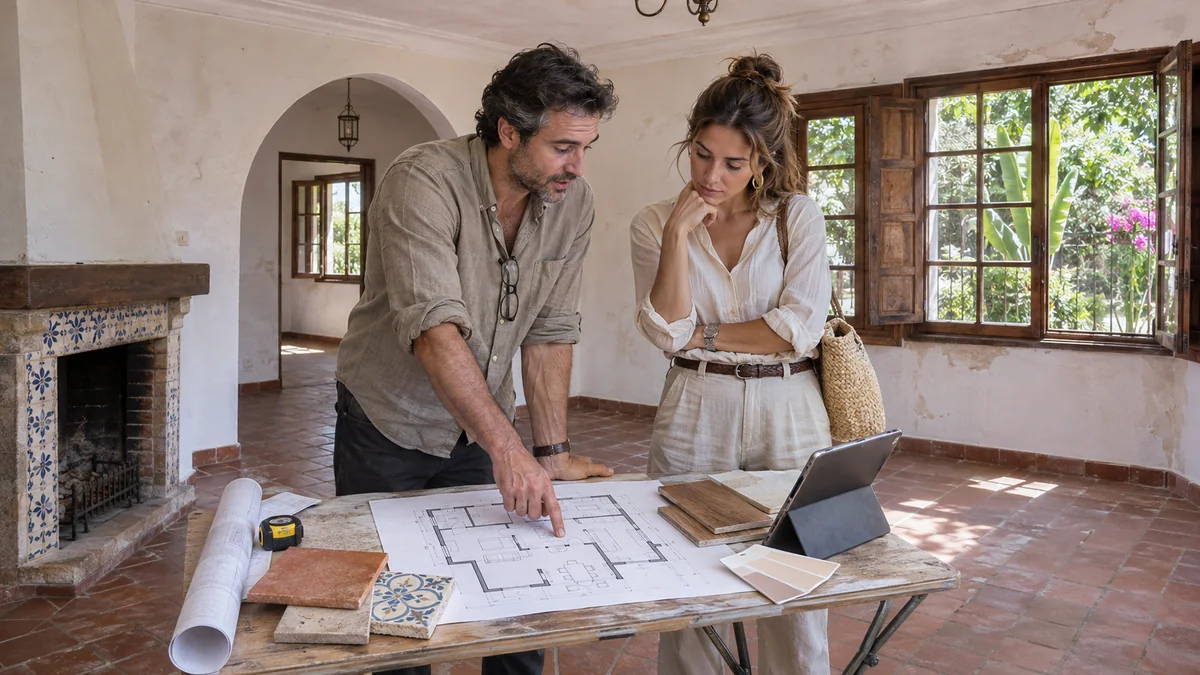
Define the home you need before pricing the makeover
Start with the changes that make the property suitable for you. Replacing dated finishes is different from creating an extra bedroom, moving a kitchen or converting a garage into living space. Write down the essential outcomes and the improvements you could postpone. This gives a technical professional something concrete to assess before you become attached to a visualisation.
Separate appearance, condition and feasibility. A tired bathroom may be straightforward to update, while attractive new finishes can conceal unresolved services or damp. Commission an appropriate condition inspection and ask what further investigation is needed for your plans. A builder's visit or design sketch does not settle structural or planning questions.
Think about how you will use the property. A holiday home may need secure storage and simple maintenance; a permanent home may need winter comfort, accessible circulation and more practical utility space. Explain those requirements early. Otherwise, a quotation for cosmetic work may leave out the changes that actually motivated the purchase.
Set a total affordability limit that includes acquisition costs and a workable home at the end. Compare that figure with alternatives already meeting your needs. Do not treat an assumed future resale premium as money available to pay today's contractors. The improvement should make sense for your plans even if the market does not reward every design choice.
Establish the legal starting point of the building
Have the lawyer and technical professional compare the actual building with its documentation. Useful material can include the deed, current registry information, cadastral details, approved plans, relevant works documents and occupation documentation. The purpose is to identify discrepancies and explain their consequences, not to collect paperwork without relating it to the rooms and structures you have viewed.
Pay particular attention to enclosed terraces, converted garages, basements, outbuildings and additions. Their appearance in an advertisement or cadastral record does not by itself establish that the use or construction is authorised. Ask what evidence supports each part you intend to rely on as living accommodation. An attractive furnished room is not proof of its legal classification.
Discuss any planning proceedings, outstanding orders or special status affecting the building. A future renovation application should not be assumed to regularise earlier work automatically. If the seller supplies a document about an out-of-planning status, ask your lawyer and architect to explain exactly what it recognises and what work remains possible under that status.
Check the planning rules for the specific plot and project. A headline about Marbella's wider planning process does not establish an individual right to extend a house. Protected buildings, sensitive surroundings and coastal locations may need additional examination. Confirm the municipality too: a property marketed as near Marbella may fall under another council's procedures.
If the essential extra bedroom depends on a space whose status is unclear, resolve that before comparing the home with properties that already have the lawful accommodation you need. A lower advertised price can be misleading when the comparison assumes usable space that has not been established.
Identify the correct route for the actual works
Marbella published an instruction on works licences and responsible declarations on 27 January 2026. It explains processing in the context of Andalusian planning law. This is useful current guidance, but it is not a blanket approval for renovations. Have the professional identify the procedure for your specific scope, building and land before work is ordered.
Andalucía's LISTA distinguishes works requiring a licence from qualifying actions handled through a declaración responsable and other applicable arrangements. A responsible declaration is a formal statement that requirements are met, supported by the required documents. It remains subject to checking and does not allow work contrary to planning rules simply because a form has been submitted.
Ask who prepares the technical documentation, who submits it, which prior reports or authorisations are needed and what must be in place before starting. Where a responsible declaration is the correct route, its effect depends on meeting the legal conditions and supplying the required material. Where a licence is needed, submitting an application is different from obtaining permission to start.
Avoid classifying a project solely as small or internal. Structural changes, use, building protection and the wider scope can matter. Ask whether a technical project, professional supervision or other appointments are required. Obtain the answer for the combined works, rather than splitting one project into informal tasks in the hope of avoiding its proper requirements.
If permissions already exist, check the approved scope, validity, conditions and any steps needed following a change of owner. A seller's old application may not cover your revised design. Put confirmed requirements into the timetable and do not plan a fixed move-in date around an unverified promise about council processing speed.
Check shared elements and the practical building rules
For an apartment or a villa within a community, investigate community requirements alongside municipal ones. Spain's Horizontal Property Law places limits on alterations affecting the building's safety, structure, external appearance or other owners and provides for prior notice of relevant private-unit works. The permissions needed for common elements depend on the proposal; there is no single vote rule for every renovation.
Windows, terrace enclosures, external air-conditioning equipment and service routes can raise issues beyond the interior finish. Give the community administrator a clear scope and ask for the relevant statutes, existing agreements and any approval process. A contractor's statement that similar work has been done elsewhere in the building is not the same as permission for your project.
Check practical arrangements too: working hours, lift protection, delivery access, waste removal and use of shared areas. Establish whether scaffolding, a skip or occupation of public space needs separate authorisation. These details can affect cost and scheduling even where the design itself is feasible. Ask who arranges them and include the answer in the quotation.
Read community information about major repairs before spending on your own finishes. If communal pipework or façade work is planned, the timing may affect your renovation. Clarify responsibilities and expected disruption with the appropriate advisers. You do not want to finish a bathroom only to discover that agreed shared works require renewed access through it.
For a detached property, do not assume every external wall, access road or service connection is exclusively yours. Check the title and any shared arrangements where the proposed work relies on them. The practical boundary of the project may extend beyond the room being redesigned.
Build a complete budget from comparable quotations
Ask contractors to quote against the same written scope, drawings and specification. A single total labelled complete renovation is difficult to compare if one quotation includes electrical upgrades and another only visible finishes. Identify quantities, materials, installation, removal, testing and exclusions. Clarify whether taxes are included and have the applicable treatment confirmed rather than assuming one rate for every item.
Include professional fees, administrative charges, any works tax, waste arrangements and access costs as relevant. Add utility alterations, equipment commissioning and temporary accommodation or storage if needed. Keep acquisition taxes and purchase costs separate so that money reserved for the transaction is not accidentally counted again as money available for the renovation.
Set a contingency based on actual uncertainties discussed with the technical team. An inaccessible roof, uncertain services or uninvestigated damp creates a different risk from a defined replacement of finishes. There is no single percentage that makes every project safe. Explain which costs are firm, provisional or dependent on further investigation before deciding your maximum offer.
Consider a hypothetical flat needing a new kitchen and an open-plan living area. The kitchen quotation may be clear, but removing a wall could require structural assessment, a different design and additional formalities. Compare a viable scheme that retains the wall with the proposed alteration. If only the more complex option meets your needs, resolve its feasibility before treating the property as a bargain.
Ask how changes will be priced and approved. Small decisions made during work can accumulate into a large increase. Keep a written variation record showing the change, price, tax and effect on timing before authorising it. A budget becomes useful when it controls decisions, not just when it produces a reassuring initial total.
Choose the team and agree how the work will be controlled
Check the contractor's identity, relevant experience, insurance and references for comparable work. Ask who manages the site and who handles technical decisions. Where specialist installers or other professionals are required, establish their roles. The person producing an attractive proposal may not be the person responsible for delivering or certifying the work.
Have the contract and scope reviewed appropriately. Agree payment milestones linked to defined progress, the handling of materials, access, changes, defects and completion documentation. Avoid leaving major sums dependent on a vague description such as nearly finished. Payment arrangements should reflect the actual contract and protections agreed, not a generic schedule copied from another project.
If you will be abroad, appoint someone with a clear inspection and reporting role. Photographs help communicate progress, but they do not replace professional assessment of concealed work before it is covered. Identify decision deadlines for tiles, fittings and equipment so that your own late choices do not create avoidable delays or substitutions.
Plan for problems discovered after opening up. Agree who investigates, who proposes the solution and who can approve extra cost. Suspected hazardous materials require appropriate professional assessment and handling; do not make removal a casual do-it-yourself task. Keep safety and technical decisions with the competent people rather than rushing to protect an optimistic timetable.
Ask what you will receive at completion: invoices, warranties, installation certificates, operating instructions and any technical or administrative completion documents applicable to the project. The exact package depends on the work. Retaining it helps with maintenance, insurance enquiries and a later sale, as well as confirming what was actually delivered.
Make the buying decision before relying on the renovation
Put the outstanding questions in order of consequence. Can the essential scheme be carried out? Is the existing property status understood? Are the total cost and funding workable? Can you tolerate the period before occupation? An unresolved answer to one of these matters may be more important than negotiating a discount on dated decoration.
Speak to your lawyer before signing a reservation or arras agreement if the purchase depends on technical feasibility or permission. Discuss how any conditions, evidence and deadlines should be expressed. You should not assume that a later refusal or expensive discovery automatically releases you from the contract or entitles you to recover the deposit.
Confirm how renovation money will be available. A mortgage offer for buying the property should not be assumed to fund all subsequent works, and money earmarked for tax or emergency needs is not spare building capital. Ask the lender about any separate requirements where financing depends on the property's condition or the planned project.
Give Costa de Oro a brief that includes your total budget, essential changes, desired occupation date and willingness to manage work. We can help compare homes against that brief and arrange viewing access. Your legal and technical team should confirm feasibility and the project requirements before you commit to a property whose suitability depends on renovation.
Common questions
Do all renovations in Marbella need a works licence?
No single procedure covers every project. Depending on the scope and property, a licence, responsible declaration or another applicable arrangement may be relevant. Have a competent professional identify the correct route and supporting documents before starting; internal or inexpensive work is not automatically exempt.
Can I trust the renovation budget shown in a listing?
Treat it as an initial indication unless it is supported by a current, detailed scope and quotations. Check what it excludes, including taxes, professional fees, permissions, services and temporary living costs. Your own design and the building's condition may change the amount substantially.
Does buying an old renovation project give me the seller's permissions?
Check the actual documents, permitted scope, validity and any change-of-holder requirements with your advisers. An application is not the same as an effective permission, and an existing authorisation may not cover your revised plans. Confirm the position before ordering work.