
Buying
Off-Plan Completion Delays: Questions to Ask Before Signing
Before you buy off-plan in Spain, ask for the date the developer actually promises and the documents that must be ready at delivery. Compare the extension clause and the refund process with your own deadlines for financing, accommodation and moving.
Published · 9 min read
By Costa de Oro · Real-estate agency · Marbella & Costa del Sol
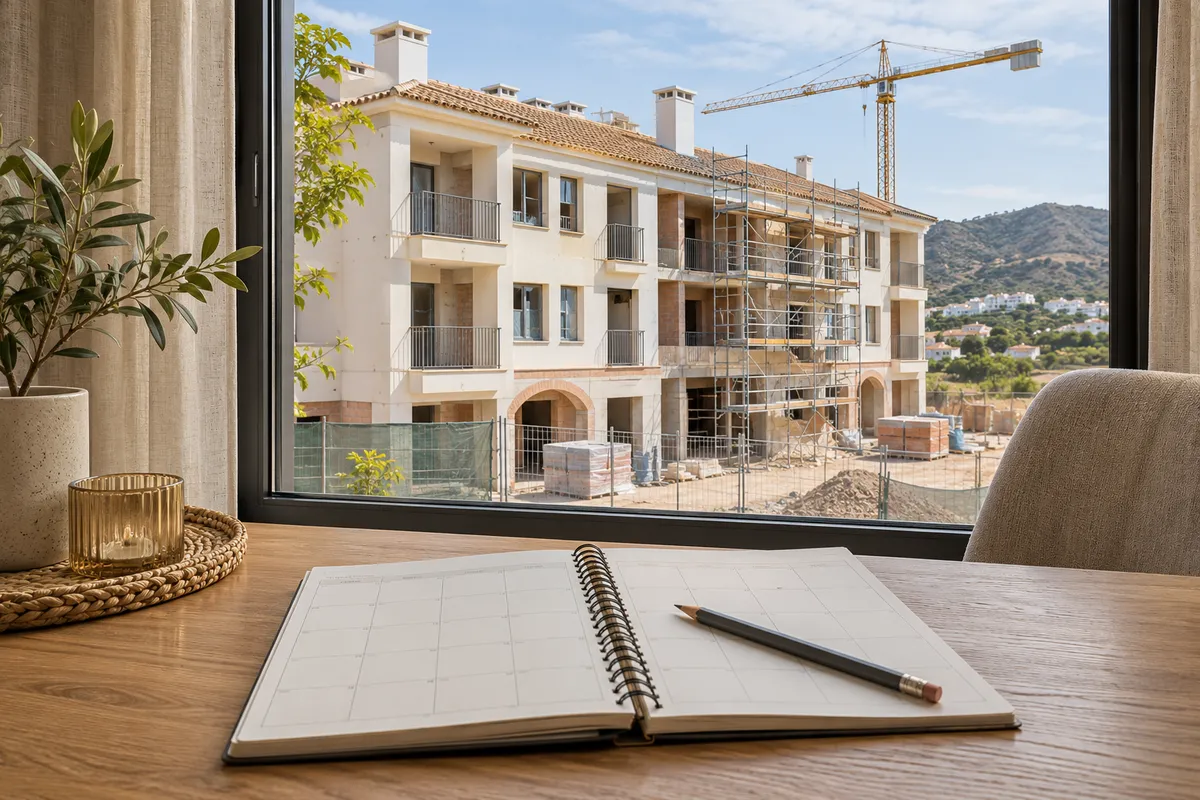
Find the date that the contract commits to
Write down the delivery date in the draft contract and compare it with the sales brochure, price offer and any reservation form. A projected quarter is useful for planning. A buyer also needs to know which provision defines the developer’s obligation, what happens if it is missed and how it applies to the particular phase. If the date depends on an event, find out when the event can be independently established and whether there is a final deadline.
In Andalusia, ask for the Documento Informativo Abreviado, or DIA, that corresponds to the stage of the home in a consumer sale covered by the regional rules. Look for the delivery information about the unit, annexes and common areas. Ask the developer to reconcile differences between the DIA and draft agreement in writing. Spain’s consumer rules also address merely indicative delivery dates controlled by the business. Ask your lawyer to check ambiguous wording before you sign.
Confirm the scope of the promise. The flat, its garage, access road and pool can have different schedules. If the lift, parking bay or accessible route is essential to you, identify it in writing and ask what must be available when the home is delivered. The date for a different block may tell you very little about yours.
Define what being ready to deliver means
Separate the end of construction, the documentation enabling first occupation, the signing of the deed and the handover of keys. Ask which documents must be available when each event happens and who supplies them. Depending on the municipality and property, the occupation route could involve a licence, applicable responsible declaration or equivalent evidence. Have your adviser check the actual procedure and the supporting file.
Review the payment schedule as well as the milestones. Identify which instalments have fixed dates and which rely on evidence of progress. Ask what the developer provides with an instalment demand. Find out how the final amount is calculated, how much notice you receive before signing and whether your adviser and lender will have time to inspect the documents.
Ask for a draft of the invitation to complete if the developer uses a standard format. An email saying that completion is close gives you limited information. A useful notice identifies the property, next action, supporting documents and relevant dates. Confirm who receives it if you buy through a representative or live abroad.
If the developer says the building is complete but the occupation file is pending, record exactly what remains. Ask whether the missing item concerns your block, a shared access or a service needed for normal use. Have your adviser explain its effect on the proposed signing date and on any request for the balance. Keep the reply with the dated timeline.
Read the extensions clause while there is time to negotiate
Look for a grace period, force majeure wording and any right to change dates. Ask whether the clause gives a fixed number of days or leaves the revised date open. Find out when notice has to be given, what proof must accompany it, and whether an extension for one stage affects other instalments or the final delivery date. Your lawyer can assess enforceability and whether the reason falls within the contract and law.
Try a hypothetical extension before you sign. If the original delivery date is 30 June and a new agreement proposes 30 September, list the practical consequences of that shift. Check whether the arrangement changes any interim payment, the issuer’s guarantee documents or the time allowed to prepare financing. A clause should be read as part of the whole contract, including its notice and termination provisions.
Ask how the developer will record a change. The Building Act contemplates an extension clause giving the new period and the dates for finishing construction and delivery when the buyer grants a qualifying extension. Have the lawyer check the addendum and coverage for payments before agreeing. Keep the original and signed amendment together so that there is a clear record of what date applies.
Decide how you will handle a missed deadline
Spain’s Building Act addresses qualifying advances when construction fails to start or the home is not delivered as agreed. Its first additional provision describes a choice between terminating with repayment of advances, applicable taxes and legal interest, or granting the developer a documented extension, in the circumstances it covers. Whether that applies to your purchase and what formal steps are needed depends on your documents, the events and the law.
Ask your lawyer who must be contacted and how to prove receipt. Under the advance protection regime, a formal demand to the developer and a 30-day non-refund period are generally part of the route to a claim against the insurer or bank. The law also addresses direct claims where a prior demand is impossible. Have the lawyer check the particular instrument, the terms of the advance and time limits before deciding how to proceed.
Keep a file of contract versions, receipts, individual guarantee documents, dated correspondence and evidence from the appropriate authority. Write one factual timeline instead of relaying changing estimates from separate sales chats. If the developer requests another payment or sends a completion invitation while there is a dispute, seek advice promptly before acting on the demand or letting a deadline pass.
Bank guarantees have a specific expiry rule. The law provides for the guarantee to lapse two years after the developer breaches the guaranteed obligation if the buyer has not formally demanded termination and repayment from the developer. Ask your lawyer to identify any earlier deadlines and to confirm which instrument you hold before deciding when to respond.
Test the cost of having to wait
Take a hypothetical buyer who expects to pay €1,250 a month for temporary accommodation after their planned move. An extra three months at the same price would cost €3,750 before storage, flights or moving charges. Add only the costs that would actually change. These numbers illustrate the budgeting method. They do not indicate landlord prices or amounts a developer must repay.
If you need a mortgage, ask when the offer, affordability checks or valuation might need to be refreshed. Find out which paperwork the lender needs and how long it takes after the developer sends it. A mortgage approval arranged for one signing window may leave questions if completion moves substantially. Keep enough time to compare options without making completion dependent on a rushed decision.
Consider your housing commitments on both sides of the move. Check when you can hand back a rental or sell an existing home and what happens if you need temporary accommodation. Plan around dates you control. Where feasible, wait for documentary confirmation before booking transport, promising rental income or giving up a place to live.
Keep a clear record while the project progresses
Agree who will send updates and what information is useful. Ask for the date of the report, the phase, what has been completed and the next named milestone. A progress photograph can help you understand the site. A dated document identifying your block and the remaining steps is more useful when you need to make a decision. Ask your adviser which evidence is relevant if the contractual date approaches.
When a date changes, note its source and status. An estimate from a sales call, a formal notice under the contract and a signed amendment belong on separate lines. Keep copies of notices with the date received and any reply. Let your lawyer know early if the dates affect a linked sale, long trip or lender deadline.
Arrange the opportunity to inspect the home before signing where the project permits it. If the developer and buyer disagree on whether outstanding work prevents delivery, the state of the property and the contractual paperwork both matter. Have the appropriate technical and legal professionals assess their respective issues.
Take these questions to your contract review
Ask your lawyer to put the key dates, dependencies and response deadlines on one page. Give the lender and project team the same window for the documents they need to provide. The purpose is to know how much time you have to act if the schedule moves.
- What exact home, annexes and facilities must be ready, and by which date?
- Which documents show lawful occupation and trigger each stage payment or the deed?
- Who can extend the date, on what grounds and with what notice?
- If delivery is missed, what refund or extension options apply, and how are notices proved?
- Do the guarantee paperwork, cash reserve and financing still work in the delay scenario?
Common questions
Is the month in an advertisement the contractual delivery date?
Check the promise in the contract and any relevant consumer information, and ask your lawyer to assess the documents together. Request a clear delivery provision before agreeing to pay.
Does every delay entitle the buyer to compensation?
The applicable remedy depends on the facts, contract and law. Repayment of protected advances, a contract penalty and recovery of extra expenses are separate questions. Give your adviser the actual documents and expenses.
What if the developer asks me to sign an extension?
Ask about the new construction and delivery dates, payments, coverage and your rights if the revised date is missed. Have the complete wording checked before agreeing.